
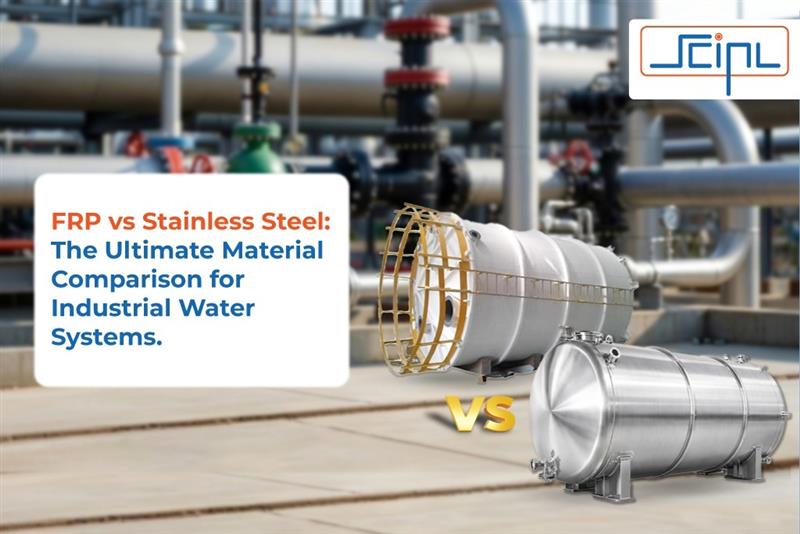
The Material Choice Dilemma
Mumbai’s industrial water systems, mainly those catering to desalination plants, chemical industries, and high-humidity coastal areas, require materials that can tolerate extreme environments. FRP vs stainless steel is an enduring dilemma for professionals in engineering and project management. The properties of both materials are different, but the selection criteria will be based on resistance to corrosion, weight, lifetime, and overall operating costs during the long term.
Corrosion Resistance in Aggressive Environments
The coastal climate of Mumbai presents the equipment with salt air and humidity. Stainless steel, although it has a long life, is still vulnerable to rust if it is in contact with chlorides for a long time. On the other hand, a standard FRP pressure vessel is unavoidably corrosion-resistant because of its non-metallic nature.
FRP is immune to salts, chemicals, and seawater which makes it the most suitable material selection for desalination projects. This property lowers maintenance costs and increases the operational time of the plant in comparison with stainless steel systems considerably.
Crevice Corrosion and Pitting
One major drawback of stainless steel in water treatment applications is crevice corrosion and pitting, particularly in joints and welded areas. Issues of the same character are being witnessed in the desalination plants and industrial ROs that operate in and around harsh environments.
A custom-made FRP pressure vessel totally disregards these risks since the product is made as a monolithic structure. No welds and joints present grant uninterrupted operation even in chemically very aggressive situations.
Structural Integrity and Weight
When comparing FRP vs stainless steel, weight plays a crucial role. FRP vessels are significantly lighter than stainless steel, which simplifies transportation and installation—an important advantage in congested industrial zones of Mumbai.
Despite being lightweight, FRP offers excellent structural integrity. A standard FRP pressure vessel can be engineered to handle high internal pressures while reducing the load on foundations and supporting structures.
Thermal Properties and Insulation
FRP thermal insulation properties are far better than those of stainless steel. This results in keeping the internal water temperatures and minimizing energy loss in the case of industrial water systems. With changing temperatures, this property of FRP not only increases the efficiency of operations but also reduces the problems caused by condensation.
Lifespan Analysis
With proper design and maintenance, a custom made FRP pressure vessel can last 25–30 years or more. Stainless steel tanks could be inspected quite often and subjected to repair works as a result of corrosion, which in turn can limit their effective lifespan. Nonetheless, FRP is demonstrated to be more economical over time, particularly in long-lasting desalination and water treatment plants.
Conclusion
FRP is the best option for modern industrial water systems, mainly because its resistance to corrosion, light weight, thermal efficiency and long life span make it especially suitable for desalination and water treatment. In case you are considering material selection desalination solutions, a standard FRP pressure vessel or a custom made FRP pressure vessel will not only significantly improve performance but also reduce lifecycle costs.
Contact Shalin Composites, a trusted FRP manufacturer today to design a solution tailored to your industrial requirements.
FAQs
1. Is FRP suitable for high-pressure industrial applications?
Absolutely true! FRP vessels can be custom-designed to handle very high pressures, like in industrial water systems.
2. How long does an FRP vessel last compared to stainless steel?
An FRP vessel is a type of vessel that can last for as long as 25–30 years, usually when pitted against stainless steel in corrosive environments.
3. What is the main advantage of FRP for installation?
FRP’s lightweight properties ensure that it can be installed much quicker, safer, and cost-effectively.
